How URL structure and signals work
🧭 One URL per locale keeps both crawlers and users oriented
- Separate language and region versions improve indexing, sharing, and destination clarity.
- hreflang should connect those URLs rather than replace them.
- A visible language switch keeps users in control instead of forcing a redirect.
Signal language and region with a clear URL structure. Choose among ccTLDs, subdomains, or subdirectories depending on your scale and workflow.
Map language variants to their URLs so Google and users land on the right page without guesswork. POEditor helps orchestrate translations for slug and metadata across languages, keeping terminology consistent. Googlebot watches how those signals travel from slug to sitemap to hreflang, ensuring crawlers discover the right regional versions.
Hreflang annotations link language and regional variants, making hreflang implementation and validation for multilingual sites essential for effective international SEO. Best practices for hreflang annotations in multi-regional sites emphasize the importance of using accurate ISO codes and including both language-only and language-plus-region variants where appropriate. By adhering to these best practices and ensuring proper validation of your hreflang tags, you can guarantee that users in different locales are directed to the correct version of your content, which hinges on a precise hreflang implementation that sidesteps common pitfalls.
Avoid relying on cookies or browser settings alone. Separate language and region versions improve indexing and sharing; offer a visible language switch rather than automatic redirects.
Canonical tags should preserve locale specificity and prevent duplicate content. Often a page should canonically reference itself in its locale.
Expert insight"Multilingual and multi-regional SEO hinges on clear language and region signals, paired with distinct URLs and precise hreflang annotations, so each audience sees the right version of your content." , Industry Analyst
Introduction
URL structure and multilingual reach
At MultiLipi, URLs with language tags, whether utilizing ccTLDs, subdomains, or subdirectories as part of our multilingual URL structure options, are integral to the site's global signaling, not just cosmetic slugs. This strategic approach to URL organization for each language enhances our ability to align content with specific regional needs and supports clearer indexing signals for search engines.
A thoughtful URL strategy targets regions and languages without adding confusion, serving as a key element of SEO for multilingual content and having a profound impact on user experience (UX) as well. Localized keyword research for each market further enhances this strategy by ensuring that the selected terms resonate with the local audience. The URL acts as the first handshake with a multilingual audience, guiding users and crawlers to the right version while enhancing visibility in search engine results. A well-structured, language-aware URL not only improves SEO by clearly signaling to search engines which language and region are being targeted but also enhances UX by making it easier for users to navigate content relevant to their language preferences. This dual benefit underscores the necessity of aligning URLs with local keyword insights to optimize both user engagement and search ranking.
We’ll outline how URL structures, hreflang signals, and scalable localization connect to deliver language versions that are easy to navigate, crawl, and maintain across Arabic, Spanish, Mandarin, and beyond.
With robust localization workflows and CMS integration, MultiLipi supports scalable multilingual URL strategies that align with real user behavior and search expectations. This section provides practical guidance you can apply today.
Different URL Structures for Multilingual Sites
Subdirectories
Keep language content under one domain, simplifying consolidation and link equity.
Subdomains
Create distinct language signals and give teams more locale-specific management flexibility.
ccTLDs
Establish a strong local presence where regional trust and geotargeting justify the added maintenance.
Subdirectory versus subdomain strategies
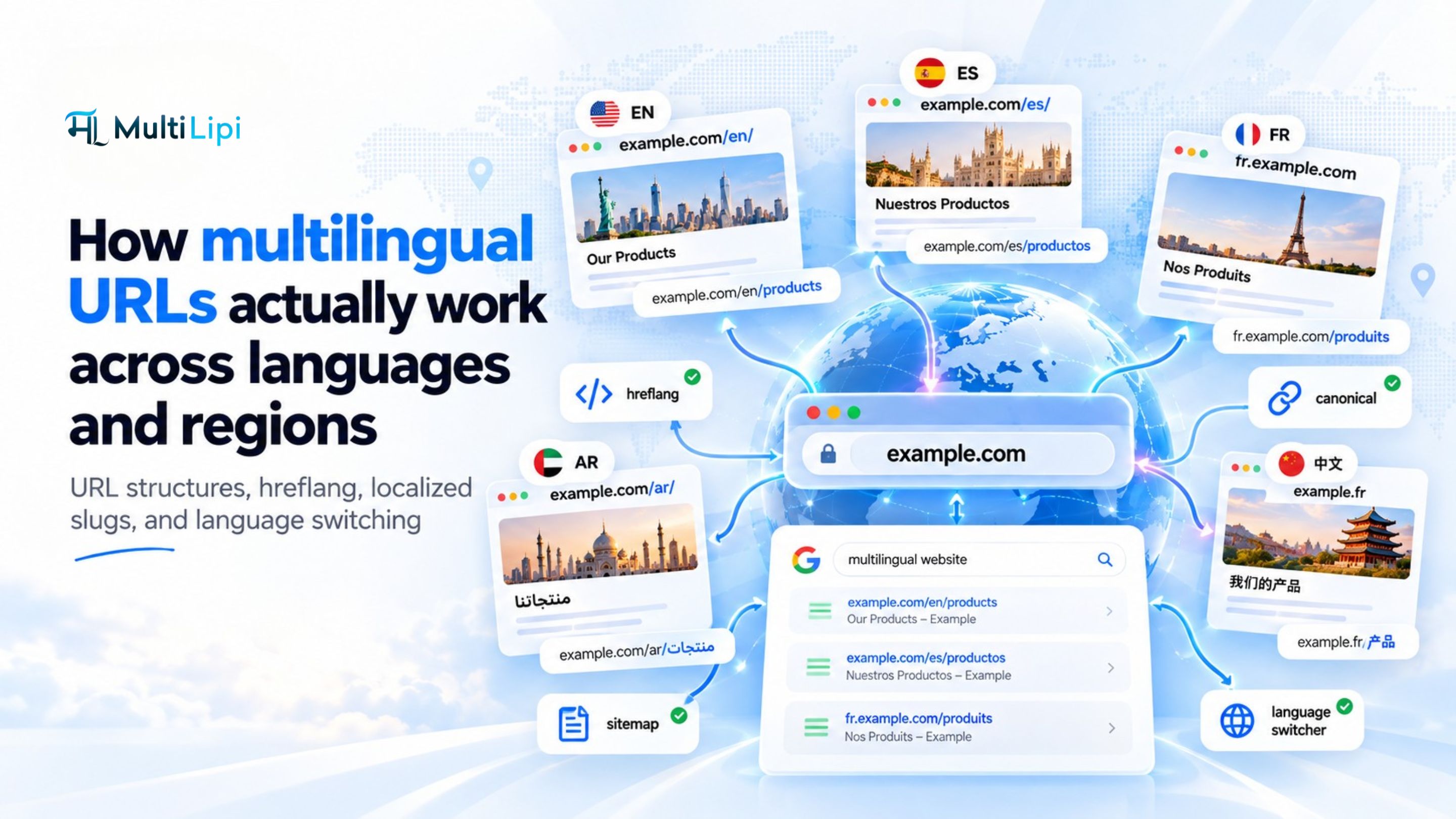
Choose a structure that scales with your content and teams, particularly when considering multilingual URL structures such as subdirectories versus subdomains versus country code top-level domains (ccTLDs). Subdirectories keep all language content under one domain, simplifying consolidation and link equity. In contrast, subdomains create distinct signals for each language, aiding locale-specific management and hosting while providing the flexibility that depends on your strategy. Meanwhile, ccTLDs serve to establish a strong local presence and may boost SEO for region-specific audiences, offering another viable path in multilingual URL structure best practices.
- Subdirectories: example.com/es/ and example.com/fr/
- Subdomains: es.example.com and fr.example.com
- Maintenance: consider your CMS and localized language selectors when publishing
Country-code top-level domains and global reach
Country code top level domains signal regional intent and can improve local trust and geotargeting with locale-specific URLs. By employing these targeted URLs, businesses can better align their content with local search habits and user preferences. They also introduce hosting and maintenance considerations. If you run many languages across regions, ccTLDs can enhance the effectiveness of geotargeting strategies, ensuring you meet local search expectations.
- Examples include us.example, fr.example, or example.fr
- Google and other engines map content to country targets using these signals
- When using ccTLDs, ensure consistent cross linking and clear hreflang tags to connect variants
Language and Region Signaling with hreflang
How language and locale map to URLs
hreflang helps Google pair each page with its language and regional variant, making the use of ISO language codes and region codes in URLs crucial for effective indexing. Utilize precise ISO language codes such as en, es, fr along with their corresponding region codes like US, FR, IN to accurately define locales within your URLs. Each language or locale variant should have its own entry in the head section or sitemap to guide indexing and delivery. When you have multiple language versions, hreflang directs Google to serve the right URL for a given user query, ensuring that the correct language and regional context are presented.
Map variants clearly to their URLs so users land on the correct page. Avoid mixing locales within a single URL and ensure consistency across content and metadata. For example, an English page targeting the US should point to a dedicated US English URL rather than a global variant.
Common pitfalls and validation checks
- Missing self referencing hreflang that declares the page in its own language and locale
- Inconsistent language region codes across pages and sitemaps
- Broken or missing alternate references during migrations or URL changes
- Relying on cookies or browser detection as the sole method to serve language without hreflang signals
- Failing to include a default x-default for unspecified locales
Validation steps include auditing alternate links on each page, testing region aware search queries, and verifying sitemap entries to ensure all language variants are represented. For insights on implementing these effectively, consider exploring multilingual SEO best practices.
Creating Scalable Localized Slugs
Start from the phrase users actually expect in the market.
Preserve meaning, script, readability, and cultural phrasing.
Publish a concise, human-friendly URL that remains consistent with the page topic.
How to translate or adapt URL slugs for each language
Slug translation should reflect natural phrasing in the target language while preserving clarity, especially when considering the difference between localized and non-localized slugs. Use concise terms that users expect in their cultural context, opting for localized slugs to enhance comprehension, and avoid literal word-for-word translations that feel awkward and confusing in a non-localized approach.
- Capture intent with locally understood terms, not just direct translations
- Prefer hyphenated, human-friendly slugs that describe the page topic
- Account for diacritics and non Latin scripts using UTF-8 encoding
- Consider IDN handling for languages with non Latin alphabets
Maintaining consistency across regions
Consistency across slugs helps users and crawlers recognize related content. Align slug patterns by language while keeping a unified naming scheme. For more insights on creating effective slugs, consider exploring slug translation.
- Adopt a common slug structure by language family, then topic
- Reuse core keywords where appropriate to maintain semantic continuity
- Document translation decisions to guide future updates
- Test slug readability in each language script and adjust for character length
SEO Considerations for Multilingual URLs
Indexation, canonicalization, and duplicate content safeguards
Plan how search engines crawl and index each language variant by considering the SEO impact of Accept-Language and Googlebot crawling behavior, which are crucial for crawlability and indexing considerations for multilingual sites. Assign a unique URL for every language version to prevent content duplication. Use canonical tags to point to the most authoritative version while preserving regional pages that serve distinct audiences, especially in the context of determining when to use canonicalization versus hreflang in multilingual pages. This not only reinforces the importance of handling locale-specific SEO signals effectively but also ensures that Google can interpret language headers and regional signals without conflating pages. Ultimately, this approach enhances your site's crawlability, thereby improving the overall effectiveness of your multilingual SEO strategy.
- Ensure each variant has a self contained canonical URL to avoid internal competition.
- Avoid dynamic changes that hide alternate language versions from crawlers.
- Align hreflang signals with canonical choices to guide indexing and avoid confusion.
Sitemaps and internal linking across languages
XML sitemaps should list every language and region variant to aid discovery on multilingual sites. To enhance locale targeting, include language and region codes in sitemap entries. Additionally, effective internal linking between language versions should be explicit, facilitating smoother transitions for users switching locales and improving overall site navigation.
- Maintain a clear, crawlable link graph across all variants.
- Use locale specific sitemaps or a single consolidated sitemap with hreflang annotations.
- Review cross linking during site changes to keep variants connected and discoverable.
User Experience and Language Switching
⚠️ Do not let automation hide alternate languages
- Automatic redirection can make alternate versions harder for users and search engines to reach.
- Keep each locale on a distinct crawlable URL and provide a persistent manual language switch.
- Test redirects, canonicals, hreflang, and sitemaps together whenever URL structures change.
Automatic language redirection versus manual selection
You should balance convenience with transparency, especially concerning language detection, user experience on multilingual sites, and managing language redirection versus user/browser language detection. Automatic redirection can speed up access but may inadvertently hide alternate language versions from users and search engines. To enhance language switching UX and accessibility for multilingual sites, if you rely on automatic changes, ensure a clear option to switch languages at any time, as this not only confirms users' preferred language choices but also elevates their overall experience. Additionally, consider users who might prefer browser language detection over forced redirection; respecting their choices is crucial for a positive interaction with your site. Moreover, be mindful of users browsing with privacy or accessibility tools that block redirects, as their needs are essential for a well-rounded user experience.
Consider using non-intrusive redirects or server-side routing that preserves the ability to view other locales. Provide a visible fallback so users can override the detected language without leaving the page.
UI patterns for language and region switching
Offer a consistent, easily discoverable switcher placed in the header or footer. Patterns to consider include:
- A compact language selector showing language names or native terms
- Region-aware options that reflect user familiarity, such as country flags paired with locale codes
- A global or locale menu that surfaces related language versions and related regional content
- A persistent switcher that remains accessible as users navigate deep into the site
Label clarity matters. Use ISO language codes alongside user-friendly names. Ensure language switching preserves context where possible and avoids sudden page layout shifts or loss of form inputs.
Technical Implementation with MultiLipi
One-line code integration and CMS compatibility
MultiLipi provides a straightforward integration path for common CMS platforms. Enable multilingual URL handling with a concise, well documented snippet. The approach supports both headless and traditional architectures while preserving your routing.
- Supports UTF-8 encoding and IDN handling for non Latin scripts
- Automatically detects ISO language codes and region tags for URL structures
- Integrates with existing sitemaps and canonical strategies to minimize disruptions
AI enabled localization workflows and URL handling
AI assisted workflows streamline translation and adaptation of URL slugs while maintaining locale appropriate phrasing. The system preserves semantic intent and yields readable slugs across scripts such as Arabic, Spanish, and Mandarin.
- Automates slug translation with quality checks to avoid awkward phrasing
- Keeps slug length and readability consistent across scripts
- Maintains alignment with hreflang signals and canonical URLs for reliable indexing
Measurement and Maintenance of Multilingual URLs
Monitoring crawlability and performance by locale
Track crawl activity for each language and region to ensure search engines discover every locale. Regularly review crawl errors, index coverage, and page depth per locale. Compare performance across geotargeted sections to identify localization gaps.
- Use locale specific logs to identify 404s and server errors by language version
- Monitor indexation status in Google Search Console for each locale
- Assess load times and CDN response by region to maintain a fast, consistent experience
Updating translations and URL structures over time
Plan periodic refreshes of translations and slugs to reflect evolving products and markets. Align URL changes with careful redirection strategies to avoid cataloging errors. Maintain consistency so internal links stay accurate after updates.
- Maintain an editorial calendar for locale updates tied to product launches
- Document slug changes and update sitemaps and hreflang mappings
- Test changes in a staging environment before deploying to production
FAQ
What is a multilingual URL and why does it matter for users and search engines?
A multilingual URL is a page address that reflects language or regional targeting, helping users land on the most relevant version of content. It also signals to search engines which language or locale to serve in results.
How should I structure URLs for multiple languages?
Best practice is to use separate URLs for each language or region version, which is essential for effective hreflang implementation. Common approaches include subdirectories like /es/ or /fr, subdomains like es.example.com or fr.example.com, and country code top-level domains like example.es. Each method has tradeoffs in scalability, complexity, and authority transfer, but leveraging separate URLs is key to signaling to search engines the intended audience for each version of your multilingual content.
What role does hreflang play in multilingual sites?
hreflang connects language and regional variants to the corresponding pages. It helps search engines serve the right page to the right user and reduces duplicate content signals across language versions.
How do I ensure proper indexing and avoid duplicate content?
Use a canonical URL for each page version alongside hreflang annotations and consistent internal linking. Submit language-specific sitemaps to guide crawlers to every locale. Avoid dynamic content swaps without explicit language indicators in the URL.
How can I measure performance across locales?
Track crawlability, indexation status, and load times by locale. Monitor user engagement metrics per language and region to identify gaps in localization or targeting.
Can a tool like MultiLipi help with multilingual URLs?
Yes. It can automate URL handling for Arabic, Spanish, and Mandarin sites, align slugs with language rules, and ensure consistency with hreflang signals and sitemaps. It supports UTF-8 encoding and IDN to handle non Latin scripts.
Conclusion
Multilingual URLs are a core element of a truly global site. Clear structures that signal language and region help both search engines and users land on the right content.
At MultiLipi, URL strategy is an ongoing workflow. AI enabled localization streamlines slug adaptation and keeps language variants consistent across Arabic, Spanish, and Mandarin while preserving essential signals like hreflang and canonical URLs.
Key takeaways you can implement now include:
- Adopt scalable URL structures that map cleanly to languages and geographies
- Use hreflang together with a strong sitemap to guide Google and other search engines across locales
- Maintain consistent internal linking and regular translation updates to prevent drift
Measured outcomes come from monitoring crawlability, indexation, and user performance per locale. When you pair correct URL signaling with rapid translation workflows, your multilingual and multi regional sites achieve clearer targeting and faster time to value.
Expert insight"Context for Relevance: truly global website. Clear URL structures that signal language and region improve visibility in Google Search and, more importantly, land users on the content they need." , Industry Analyst
Useful MultiLipi guides and tools for multilingual URL implementation
These resources cover hreflang validation, slug translation, sitemap checks, language switching, and multilingual SEO implementation.